
8 September 2026
How Play-Based Learning Enhances Child Development?
How Children Learn Best Through Play
Walk into any preschool room and watch for five minutes. You might see a child stack blocks into a wobbly tower, knock it down deliberately and laugh as they discover what happens. Nobody told them to do that. They just did it, because it felt good and they wanted to see what would happen.
People used to treat play like the fun bit squeezed in around the “real” learning but this is no longer the case. Play isn’t the break from learning. Most days, it’s the whole lesson, dressed up as a game so nobody has to sit still and be taught at. In early childhood, play is a crucial learning environment. Te Whāriki is a play-based curriculum in Aotearoa New Zealand which helps children to develop through exploring, communication, relationships and experiences.
What is play-based learning?
Through meaningful play, exploration, interaction, and discovery, children can acquire knowledge, skills, and learning dispositions through play-based learning. Te Whāriki offers a play-based early childhood curriculum in Aotearoa New Zealand that promotes child’s overall development.
Why Play-Based Learning Matters for Preschoolers
If you try to teach a three-year-old in the same way you might teach a ten-year-old, you may quickly lose their attention. Young children typically learn through active, hands-on experiences, movement, interaction and exploration. What works instead is something they can touch and break then try again badly, over and over until it finally clicks.
Watch a child pretend to run a shop. They hand over pretend money, count items and work out change. What looks like simple pretend play can involve early mathematical thinking, communication and social interaction. A fort built out of couch cushions is the same story. Someone’s working out balance and weight and what happens when you pull the wrong cushion at the wrong time, usually the hard way, with the whole thing collapsing on top of them. Nobody wrote a lesson plan for that.
Pushing formal instructions on a preschooler too early usually backfires more often than not. If you sit a tamariki down with a worksheet before they’re ready, you may see resistance or frustration rather than meaningful engagement. Wrap the same skill in a game, though, and they’ll ask to do it again tomorrow, and the next day.
What Kids Actually Get Out of Playing
One afternoon of play can hit five different parts of a child’s growth at once, and none of it feels like work for them.
Running around the playground builds strength and balance. Sharing a set of blocks, and fighting over who gets to be the Police Officer, teaches negotiation faster than any adult lecture on sharing ever could. Children acting out a trip to the doctor with a toy stethoscope is working through something that actually scared them, in a way that feels safe because they’re the one holding the stethoscope this time. Stack cups, knock them down, stack them again. That’s problem-solving building itself, one tower at a time.
None of this learning happens in a straight line, and it doesn’t have to.
Read This – Transitioning from Preschool to Primary School
How Does Play-Based Learning Benefit Toddler Development in NZ?
Play-based learning can support children’s development across several areas, including
- Social skills
- Communication
- Problem-solving
- Creativity
- Physical development
- Emotional development
- Early literacy
- Early numeracy
- Independence
- Confidence
What This Actually Looks Like in a Classroom
A good early preschool centre doesn’t simply hope play happens. They build the room around it, on purpose, and it shows the second you walk in.
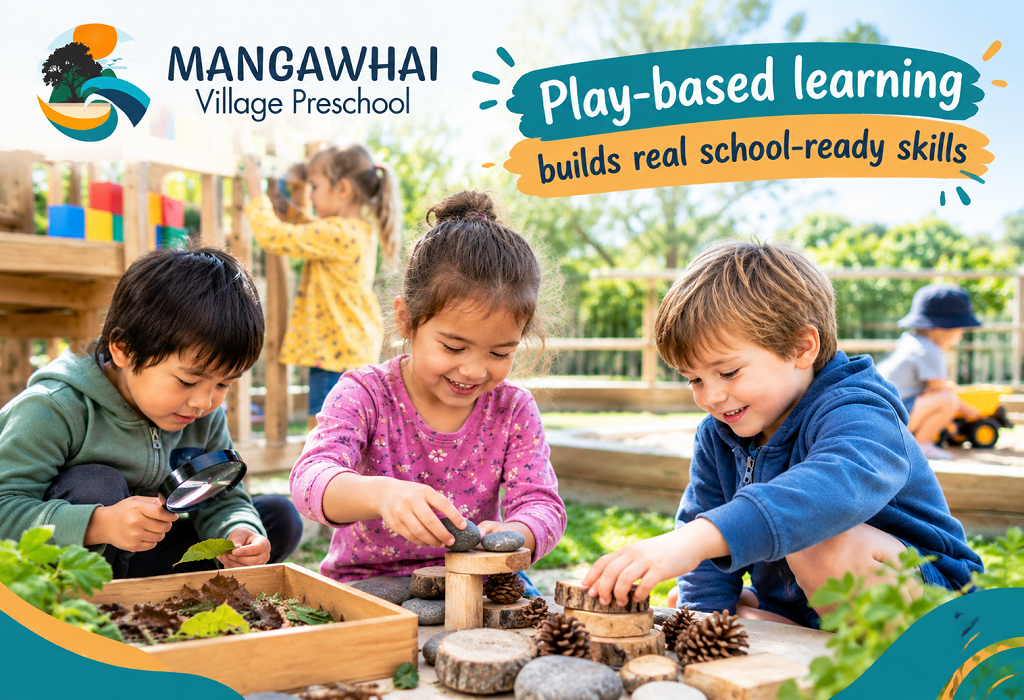
A sensory bin full of rice or water lets a toddler dig in and figure out texture on their own terms, no instructions needed. A dress-up corner set up gets the kids talking and negotiating roles and arguing over who’s the patient this time. Time outside, room to run and climb and taking small risks, builds a kind of confidence you can’t fake. And when an educator reads a story then hands it over for the kids to act out themselves, reading stops being something done to them and turns into something they own.
Here’s the mistake we see countless centres make: leaning on one of these and skipping the rest. Children also benefit from social and imaginative play, where they can practise communication, cooperation, negotiation and taking turns. And that mess, the arguing over roles and negotiating who goes first, is half the point.
The best thing we can do for their learning is to provide a range of scenarios and challenges to purposely help our children grow, then dress it up as a fun game to keep everyone actively engaged.
Play-Based Learning Activities at Mangawhai Village Preschool
At Mangawhai Village Preschool on Molesworth Drive, play-based learning is an important part of our curriculum, informed by Te Whāriki. Our approach provides children with opportunities to explore, create, communicate, solve problems and develop confidence through meaningful play. At MV Preschool, we use different interactive group activities to build lifelong problem-solving skills, such as:
- Dramatic and Pretend Play
- Constructive Play
- Sensory Play
- Storytelling and Puppet Play
- Outdoor and Nature Exploration
- Dress-up and Role-Play
- Block Building
- Playdough Sculpting
- Finger Painting
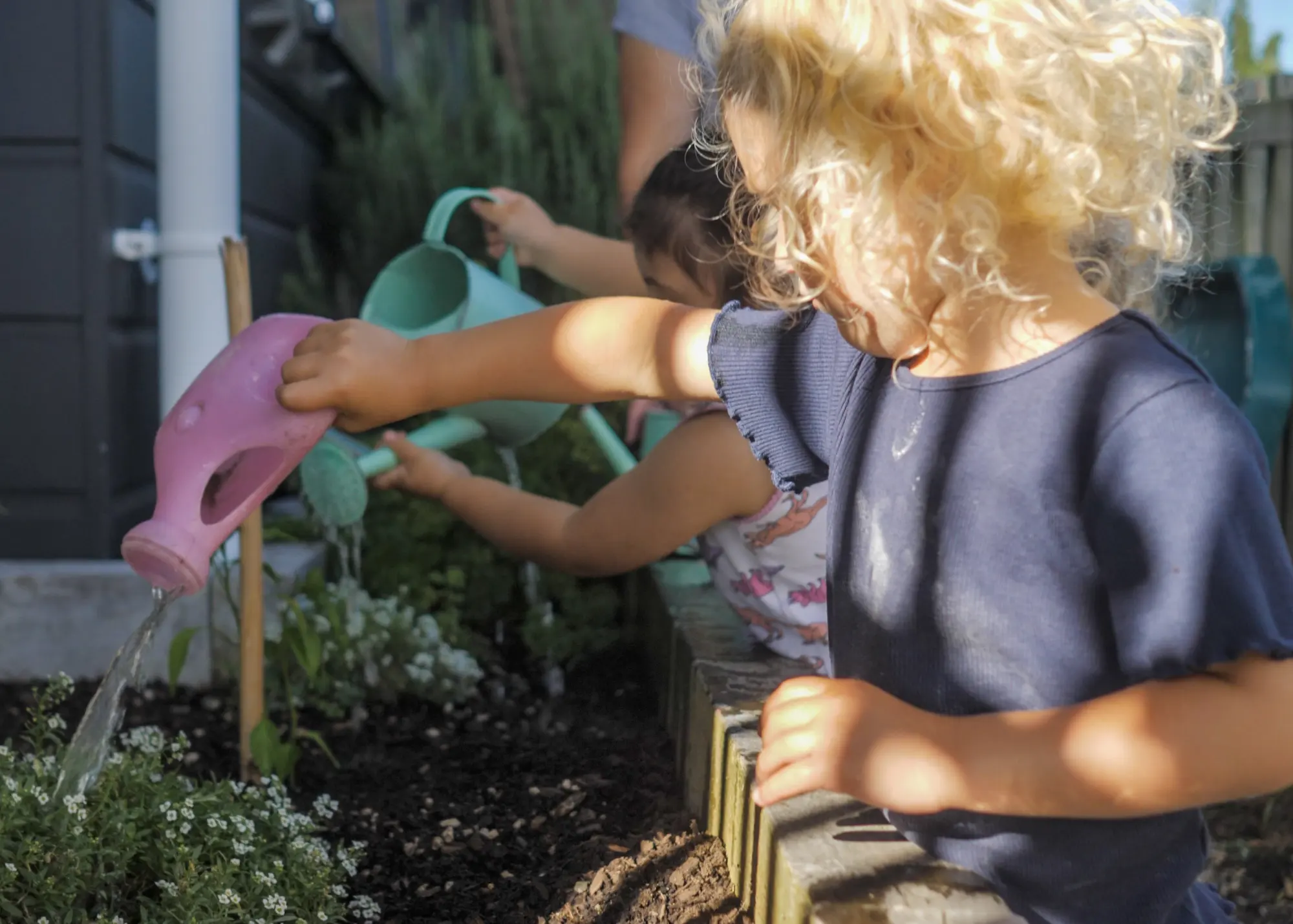
- Gardening
- Simple Board Games
Enrol at MV Preschool
FAQ
Q 1. At what age does play-based learning work best?
All through early childhood, though it just looks different for each age and stage. Toddlers generally gravitate toward sensory and physical play, the stuff you can grab and dump or bang together. Preschoolers start getting into pretend play with actual rules and roles, and the arguments that come with them.
Q 2. Does play-based learning replace teaching letters and numbers?
No, and it’s not trying to. It builds the foundation for those skills. Sorting, stacking, counting and pattern-making can provide children with opportunities to explore early mathematical ideas in meaningful contexts. These experiences can support later formal learning.
Q 3. How do I know if a preschool actually takes play seriously, or just says it does on the website?
Look at the room, not the brochure. Take a tour. If there are multiple activity zones, materials like blocks and dress-ups that don’t have one right way to use them, and long stretches where nobody’s herding kids from one activity to the next, that’s what it looks like in practice. A room full of laminated worksheets tells you a different story.
Q 4. Do parents need to do anything special at home to support this?
Honestly, no. Cardboard boxes, pots and pans, and unstructured time in the backyard do more for a young kid than most of the branded educational toys so don’t worry. Having less toys and structure opens up more opportunity for imagination and play.
Sources and Further Reading
Te Whāriki – Early Childhood Curriculum (Ministry of Education / Tāhūrangi)
Learning Through Play (Te Whāriki Online)
A New Zealand based parent guide to how children learn through play, the skills that can be developed through play, the role of play in preparing a child for school, and how Mangawhai Village Preschool incorporates play into the curriculum.
Want to see play-based learning in action at Mangawhai Village Preschool?
We welcome families to visit our purpose-built early learning centre on Molesworth Drive and learn more about how children learn through play, exploration and meaningful experiences. Contact our team to book your visit.
Come and see
Come and see the centre.
Half an hour on a tour, while the centre is busy. You are very welcome to bring your child along.